
Entry-level healthcare work is changing faster than staffing models can track
AI isn’t eliminating entry-level healthcare jobs. It’s absorbing the repeatable tasks inside those jobs, such as documentation, intake triage, and scheduling, while leaving licensing, judgment, and direct patient care to the clinician. Healthcare hiring for early-career roles keeps growing even as this shift accelerates, but most staffing models still aren’t built to track it.
Randstad’s recent analysis of AI and the healthcare workforce documents the anxiety this creates among early-career workers and points to what employers can do about it.¹ The part that matters most for staffing leaders sits underneath the headline: the roles aren’t disappearing, but the tasks inside them are shifting faster than most staffing infrastructure was built to track.
The task is disappearing, not the job
Entry-level clinical and administrative roles have long been defined by their most repeatable tasks: recording vitals, updating charts, triaging intake calls, building schedules. AI tools absorb exactly these tasks first. Randstad found that most healthcare professionals feel ready to use new technology in their roles, and a majority say automation gives them more time for the parts of the job that require judgment and human presence.¹
A medical assistant who used to spend a third of a shift on documentation now spends that time on something else. For facilities, that changes what adequate staffing means. Headcount math built around the old task mix will misjudge capacity going forward.
Workers are upskilling on their own
Randstad’s data shows a meaningful share of healthcare workers already pursuing AI literacy without waiting for an employer program to point them there.¹ Read that two ways. The workforce is more ready for AI-assisted workflows than most staffing models assume. And facilities without a structured upskilling path are leaning on individual initiative to close a gap that belongs to the organization. That approach tends to break first in the roles with the highest turnover, which in healthcare skew entry-level.
The overlap with workforce planning shows up here directly. A float pool nurse or a per diem tech moving between units needs the same baseline AI-assisted charting and documentation fluency as a full-time employee, and often needs it faster, since they spend less time embedded in any one system to pick it up informally. Credentialing and onboarding processes that skip this build a two-tier workforce: employees who get structured AI training, and contingent staff left to figure it out shift to shift.
Staffing models, not just training programs, need to adapt
Most public discussion of AI and healthcare labor focuses on training content: which skills to teach, which curricula to adopt. Fewer people are naming the staffing problem underneath it. A staffing model built for a stable, slow-changing task mix breaks down once the task mix itself keeps moving.
Three implications follow directly:
- Fill decisions need to weigh tooling alongside credentials. A clinician credentialed for the role but unfamiliar with a facility’s AI-assisted documentation system won’t be fully productive on day one. Facilities that add tooling fluency to their fill criteria, alongside licensure and specialty, get more usable capacity out of every shift.
- Contingent workforce strategy needs to include upskilling, not just sourcing. As AI literacy becomes table stakes, agency and per diem staff left outside the training perimeter widen the gap between a facility’s internal and external workforce. That gap surfaces as inconsistent quality and slower fill-to-productivity time, even when the fill rate itself looks healthy.
- Retention planning should treat AI readiness as a real variable. Randstad links feeling equipped to use new tools to stronger workforce engagement and retention.¹ For facilities already fighting turnover, that connection belongs on the staffing cost line, not in a soft HR metric.
What workforce leaders can act on
Healthcare staffing leaders don’t need to become AI strategists. They need the staffing function to widen its definition of “ready to work” to include tooling fluency, and to apply that standard to every clinician on a shift: employed, per diem, or agency-sourced.
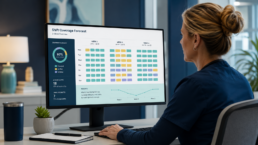
This starts as a data problem. Most facilities can already confirm a clinician’s license and availability. Few can confirm, at the moment a shift needs filling, whether that clinician is also current on the systems the facility runs, or catch a credentialing gap before it turns into a compliance issue or a payroll correction after the fact. Staffing updates scattered across spreadsheets, emails, and informal handoffs make that kind of visibility hard to build for employed staff alone, let alone across internal and contingent workers at once.
Facilities that solve this treat readiness, not just credentialing status, as part of what makes a clinician shift-ready. They build that visibility into how shifts get filled in the first place, and it shows up in outcomes: fewer late corrections, faster time to productivity, and a workforce that isn’t split into a trained tier and an untrained one.
The next round of survey data will likely repeat what frontline staff already know. Facilities that treat this as a staffing infrastructure question now won’t need the survey to tell them.
Frequently asked questions
Is AI eliminating entry-level healthcare jobs? No. Entry-level hiring in healthcare continues to grow. AI is absorbing repeatable tasks within those roles, such as documentation and scheduling, which changes the skill mix the job requires rather than removing the job itself.¹
What AI skills do entry-level healthcare workers need now? Baseline fluency with AI-assisted documentation and charting tools is becoming a standard expectation alongside licensure. Many workers are already pursuing this on their own, ahead of formal employer training programs.¹
Do per diem and agency clinicians need AI training too, or just full-time staff? Contingent clinicians need the same tooling fluency as employed staff, often faster, since they spend less time embedded in any single facility’s systems. Skipping this creates a two-tier workforce split between trained and untrained clinicians.
How should healthcare facilities measure staffing readiness for AI-assisted work? Facilities should track tooling fluency alongside licensure and specialty when making fill decisions, and build visibility into credentialing and onboarding status so gaps surface before a shift starts, not after a compliance issue or payroll correction.
Sources: AI and the healthcare workforce: what HR needs to know, Randstad USA (May 2026).
¹ Statistics and findings referenced throughout are drawn from Randstad’s analysis, cited above.