
Healthcare AI adoption is outpacing workforce infrastructure
Four out of five physicians now use AI at work
A new report from Cardinal News and Carilion Clinic puts a number on bedside adoption: four out of five physicians use AI tools in daily clinical workflows. Note-taking, order preparation, and patient message summaries. Carilion is rolling out AI agents directly into nursing workflows in 2026, with an explicit goal of reducing administrative burden on the largest segment of the clinical workforce.
Clinical AI has crossed from experiment to operating standard. Health systems that invested early are seeing measurable gains in documentation, care coordination, and patient communication. Clinicians work inside AI-augmented systems. The organizations deploying those systems are building competitive advantage in recruiting, retention, and throughput.
The workforce infrastructure gap
The disconnect: health systems are investing heavily in clinical AI while the workforce infrastructure behind those clinicians still runs on disconnected tools, inbox workflows, and manually managed agency relationships. How shifts get filled, how contingent labor gets sourced, how float pool utilization gets tracked, that layer hasn’t kept pace.
The gap between what health systems invest in at care delivery and what they tolerate at workforce operations has a measurable cost.
Workforce leaders without real-time visibility into internal utilization reach for contingent labor before they need to. Agency sourcing comes at full markup. Late-surfacing gaps get filled expensively, often by the same traveling nurses the system was trying to reduce reliance on. A health system running a sophisticated AI documentation platform while filling nursing gaps via agency email threads is operating two different eras of technology at the same time.
The inefficiency is visible in Q3 labor variance, in agency spend that resurfaces every budget cycle, and in workforce leaders who know what the problem is but can’t act before gaps hit the floor.
What AI-augmented clinical workflows actually require
Physicians use ambient documentation to cut note burden. Nurses move faster through patient message queues with AI-generated summaries, and residents get order preparation support that reduces decision latency.
Each use case makes one assumption: the right clinician is in the right place when the AI assists them. Clinical AI optimizes the work of the people already there, but it doesn’t solve for when those people aren’t there, or when the wrong mix of experience levels is staffed against an acuity level the AI flagged, but the schedule didn’t anticipate.
The intelligence layer built for clinical workflows needs a parallel build on the workforce side. Running a health system on reactive, fragmented workforce data in 2026 is the equivalent of running clinical documentation on paper charts.
Predictive workforce intelligence: what it looks like in practice
Predictive workforce intelligence differs from traditional workforce management on three dimensions.
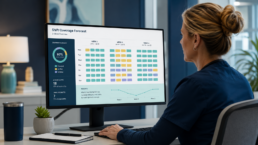
Demand forecasting. A predictive system models expected demand from census trends, historical utilization, seasonal patterns, and acuity data. Workforce leaders see where gaps will likely form before they form, and have time to fill them with internal staff rather than agency.
Proactive staffing recommendations. When internal float pools have capacity, the system surfaces it before a manager calls a traveler. When internal supply is genuinely constrained, it routes requests to contingent sourcing without delay. The decision logic lives in the system, not in a workforce manager’s head.
Unified supply visibility. Most health systems carry workforce data across an internal workforce management tool, agency portals for contingent labor, and spreadsheets for float pool tracking. Predictive intelligence consolidates that visibility so leaders see internal and external supply in one place, in real time, against forecasted demand.
The result is a workforce operation that can keep pace with the clinical systems it supports.
The operational control tower your clinical AI needs
Talent Fusion Optimize is the predictive intelligence layer for workforce operations: demand forecasting, proactive staffing recommendations, and visibility across internal and contingent supply before gaps reach the floor.
Your nurses are working inside intelligent systems, the scheduling infrastructure behind them should be one too.
Talk to a workforce strategist
If your health system is investing in clinical AI and still filling contingent gaps reactively, those two investments aren’t working together. A workforce strategist can map where predictive staffing intelligence fits your current operating model, and what reducing late-stage agency reliance would mean for your 2026 labor budget.
Speak to a workforce strategist