Turning workforce data into proactive staffing decisions
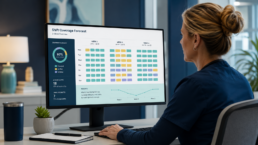
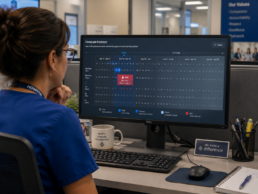
Hospitals have no shortage of dashboards, but many leaders still can’t see staffing gaps far enough in advance to avoid costly last-minute coverage.
Hospital leaders have invested heavily in staffing technology over the past decade, yet many still struggle to answer a basic operational question: will we have enough clinicians to cover shifts three weeks from now?
New survey findings highlighted in the 2026 Healthcare Workforce Outlook from Cross Country Healthcare suggest that even with widespread adoption of scheduling tools, healthcare leaders continue to report visibility gaps driven by disconnected systems. Many organizations have the data, but not the decision-ready insight that turns information into earlier action.
That disconnect is becoming more consequential as financial pressure rises. Seven in ten healthcare leaders surveyed expect labor costs to keep increasing, while fewer than half say they feel confident forecasting workforce needs accurately. The challenge, leaders indicate, is less about collecting more data and more about making existing data usable across teams, departments, and time horizons.
A decade of tools, and still reactive staffing
Most health systems run multiple workforce platforms across scheduling, VMS, HRIS, and EHR environments. The tools often solve narrow problems well, but they rarely share data cleanly. The result is a staffing model that can look controlled on paper, while day-to-day operations remain reactive.
When gaps emerge late, leaders have fewer options. A short unit at 5 p.m. is a scramble, and the fastest solution is often the most expensive one.
AI forecasting is gaining traction, but only with the right foundation
A growing number of healthcare organizations are looking to AI-driven workforce platforms to forecast staffing gaps earlier by analyzing historical staffing patterns, census trends, seasonal demand, and labor market signals.
Industry data suggests adoption is accelerating. The GRID 2026 Industry Trends Report found that top-performing staffing firms are significantly more likely to use AI than their peers, a sign that the performance gap between adopters and non-adopters may widen.
But leaders and operators caution that AI is only as effective as the data it’s built on. Forecasting tools trained on fragmented, inconsistent inputs often produce outputs that are equally unreliable. For many organizations, the first step is a more cohesive workforce data strategy.
What’s changing at leading organizations
Health systems making the most progress tend to follow a similar playbook: consolidate workforce data before layering on advanced analytics.
That means creating a single source of truth that captures, across departments, internal staff utilization, float pool availability, per diem activation rates, and agency spend. With that foundation, organizations can use analytics to identify patterns that are easy to miss manually, flag anomalies earlier, and model “what-if” scenarios when census shifts or new service lines launch.
Operational orchestration also plays a role. Platforms like Medely’s Talent Fusion are designed to manage internal staff, float pool, per diem, and travel labor in one place. The goal is to reduce handoffs and gaps between systems, while improving data consistency so workforce intelligence tools can generate more reliable forward-looking signals.
The bottom line for 2027 planning
For many leaders, the near-term imperative is straightforward: the organizations best positioned to manage labor costs in 2027 will be the ones investing now in the data infrastructure, policies, and operating discipline needed to act earlier.
AI can surface the signal, but sustainable improvement still depends on leadership judgment and the operational ability to respond before staffing shortages become emergencies.