

The staffing themes for 2026 are simple: consistency and strategic planning.
No administrator likes a staffing scramble, but last-minute shifts can affect patient care and lead to miscommunications, rushed decisions, or high staff-to-patient ratios.
But administrators aren’t the only ones who see the effects.
We surveyed almost 300 nurses and health professionals to understand how staffing decisions are impacting them and learn how administrators can make changes for a stronger, more advanced workforce.
Survey findings
The survey findings show the key to a successful healthcare facility boils down to one thing: the staff.
You can have the right number of beds, location, administration, and strategy, but when your workforce is unstable, you’re capping your success.
Patient-driven staffing isn’t just sending out schedules and filling gaps; there’s an art to it. You have to take into consideration the entire image rather than just one piece of the puzzle.
This is why it’s important not to treat staffing as an afterthought, but the most important factor for ensuring positive patient outcomes. But our survey shows that 56% of nurses find that most of their shifts are last-minute rather than planned.
Because administrators are constantly playing catch-up, the majority of available shifts end up as last-minute requests.
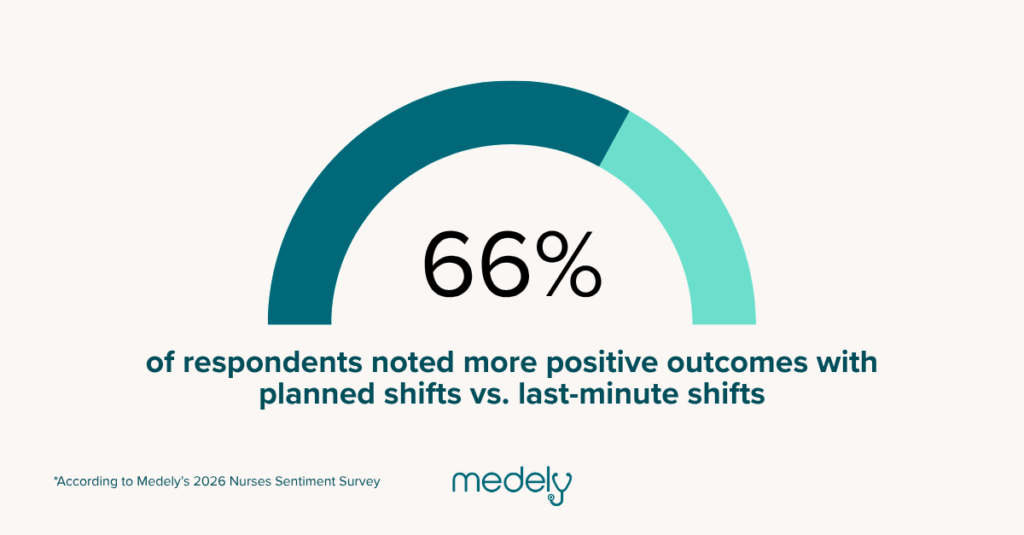
The kicker? 66% of nurses shared that they noticed more positive patient outcomes, less staff stress, and greater overall consistency when shifts were planned versus last-minute.
Healthcare facilities will always have last-minute needs, but there needs to be a mindset shift to a more proactive, data-driven approach to staffing.
When administrators prioritize proactive staffing, they have better control over their strategy, which can greatly reduce staffing inconsistencies, rather than just putting a band-aid over a problem that, if left unaddressed, will become a cycle.
Finding consistency with external staff
In the midst of constant fluctuations, finding a consistent rhythm with full-time, part-time, and per diem staff might feel impossible, but most facilities are building a trusted workforce, even with external staff.
One of the ways they’re doing that is by utilizing repeat nurses and health professionals with Medely’s favorites feature. After a nurse or health professional finishes a shift, facilities can favorite them to prioritize them for future shifts.
It’s a way to create a go-to pool of per diem nurses and health professionals who understand the facility, are familiar with the specific protocols, and can integrate with full-time staff the way that administrators need–all on an as-needed basis. Our favorites feature offers the flexibility of per diem with the trust of an internal float pool.
And most facilities are taking advantage of it.
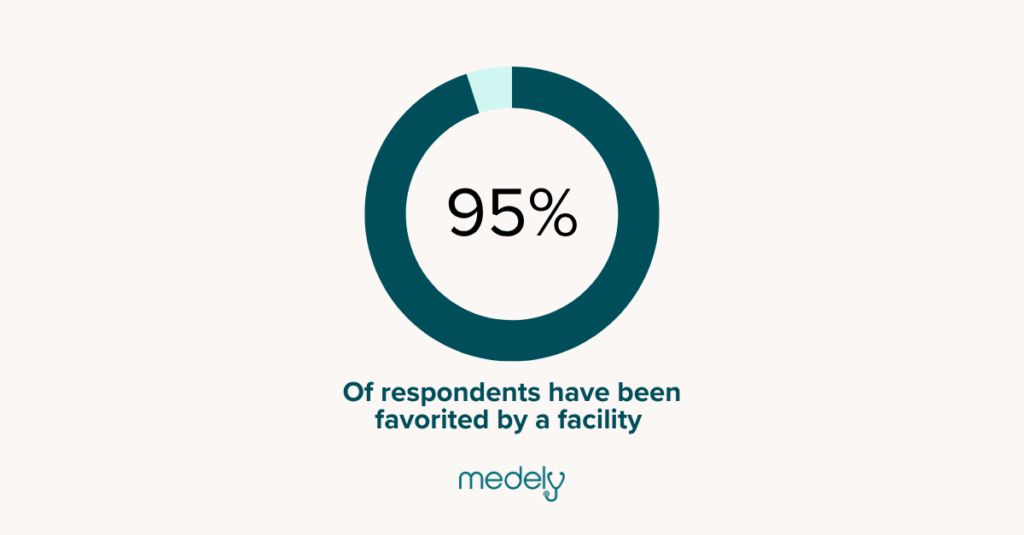
95% of nurses and health professionals interviewed shared that they were a favorite at at least one facility, and of those, almost 60% are picking up shifts at favorited facilities at least once a week, if not more.
When asked about their experience as a favorite and correlation with patient outcomes, most nurses stated that they had seen a positive correlation with patient outcomes, staff stress, and caseload when they are a favorite.
“If I am placed as a favorite, then I am knowledgeable of their preferences, the caseload for the week, and other small details that are important to the doctors. I don’t have to spend time preparing if I already know what I’m doing and I already know what the doctor needs,” one surveyed professional shared.
Every second in healthcare matters, so when tedious processes can be streamlined and even more effective, the whole unit thrives.
Consistency leads to better patient outcomes
Strong partnerships between healthcare facilities and healthcare workers are critical to achieving positive patient outcomes. When patient care is at the forefront, everybody wins.
Our survey results showcased some of the incredible work that nurses and health professionals are putting into caring for their patients.
“I had a patient who had been seen several times before and knew all the staff. She was very nervous and asked me lots of questions because she had never seen me. She was certain I would not get her IV in because she said she was a hard stick. I talked to her and made her feel comfortable and confident in me, and when I got her IV placed, she was so happy and relieved,” one professional shared.
“At the high-paced pre-op job at the advanced health center where we do eye surgery, I start IVs for patients. Since that’s the one thing patients dread the most about surgery, it definitely makes a big impact when the skills are good. They ask for me by name every time they come back for the other eye,” another professional shared.
Offering healthcare workers more flexibility might feel more counterintuitive to building a stable workforce, but time and time again, the data shows that giving healthcare workers more flexibility creates stronger, more resilient healthcare professionals.
Post shifts on Medely today
As we kick off Nurses Week, it’s important to remember that strong healthcare facilities are powered by outstanding healthcare workers.
Creating a collaborative environment for nurses and health professionals will always help create a more effective healthcare environment for all.
Are you a nurse or health professional looking to find a better work-life balance? Start your free profile with Medely here.
Are you a healthcare facility looking to book vetted nurses and health professionals? Schedule a demo here.