
What facility leaders should build before demand moves again
Staffing Industry Analysts’ latest Pulse Survey shows travel nurse revenue up 1% among participating firms, with most segments settling into moderate growth after four years of pandemic surge, correction, and uneven recovery. Rate volatility has eased, but coverage risk hasn’t.
A 1% travel nurse increase is a planning signal
Demand for contingent clinical coverage has normalized, but at a level facilities still need to plan around. Instead of the reactive cost-cutting of the correction years, leaders are back to capacity planning. Rate volatility has eased, and contingent labor budgets are holding steadier as a result.
The supply problem hasn’t gone anywhere. HRSA still projects a national registered nurse shortage through 2038. Patient acuity remains high, and outpatient volume keeps climbing. For the first time in a while, facilities can plan ahead instead of scrambling to fill tomorrow’s schedule.
Coverage pressure remains uneven by role and setting
Coverage pressure varies sharply by specialty and care setting.
Anesthesia coverage is tightening. CHG Healthcare acquired KREWE Anesthesia this week, citing the national CRNA shortage and its severity in rural markets. Large firms are buying capability they expect to stay scarce. For ASCs, anesthesia coverage determines whether the full case schedule runs, and administrators are finding that constraint more expensive to solve through traditional contracts. Competition for perioperative talent has sharpened as hospitals pull FTEs from ASC talent pools.
Post-acute planning is exposed to Medicaid uncertainty. PACE programs face expansion headwinds as states work through Medicaid funding constraints. SNFs and post-acute providers already carry heavy per diem dependence. With budgets uncertain, finance teams have a harder time defending fixed FTE commitments, and flexible coverage becomes more valuable by comparison.
Administrative capacity is thinning. Sharp HealthCare cut roughly 260 positions this week. When systems trim, administrative and scheduling roles go first, and those are the people who coordinate contingent coverage. Clinical demand holds steady while the staff who manage it disappear. Within a quarter or two, that gap shows up as unfilled shifts.
Five ways to build bench depth in a calm market
- Size the bench against real gap volume. Pull twelve months of open shift data by unit, role, and day of week. Most facilities find a small set of predictable patterns driving most of their coverage gaps. That data gives you a specific number to staff against.
- Credential ahead of demand. Slow credentialing keeps a willing clinician off the schedule. Medely cut average credentialing time from 14 days to under 24 hours. That’s the gap between a covered shift and a closed OR. See Medely’s workforce orchestration framework for how the credentialing layer fits the wider staffing model.
- Build depth from people who already know the facility. Clinicians who return need less orientation, carry less clinical risk, and perform like core staff. A managed pool of returning, credentialed professionals delivers that continuity, and inviting favorite clinicians first is how facilities build it shift by shift.
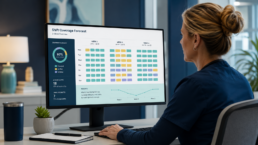
- Put coverage data in front of nursing and finance at the same time. Share the same forecast of where gaps concentrate with both nursing and finance so they stop debating premium spend after the fact and start preventing it.
- Define the escalation path before the schedule breaks. Escalate from internal float to the per diem bench to on-demand coverage, in that order, with each step triggered by a documented rule. Medely’s guide to per diem and float pools covers how the first two layers work together.
Build the bench before demand moves again
Facilities that read stabilization as permission to go back to ad hoc agency calls and reactive shift posting will land right back in their 2022 position the next time demand moves. The structural shortage never went away, it just got quieter. Build the bench while it’s quiet, before the next surge makes that decision for you.
Frequently asked questions
What does modest staffing growth mean for a labor budget?
Rate volatility has eased, so contingent labor spend is easier to forecast than it’s been since 2021. The planning risk has shifted from price to availability: a budget can be accurate and coverage can still fail if credentialing and bench depth aren’t in place.
Why is anesthesia coverage still difficult when the broader market has settled?
CRNA supply stays concentrated while demand keeps rising with ASC and outpatient volume. Rural markets feel it first. CHG’s acquisition of KREWE Anesthesia signals that access to credentialed anesthesia talent has become a competitive advantage.
How large should a per diem bench be?
Size it against actual gap volume. Twelve months of unfilled shift data by unit and role gives you the number. The bench should absorb a normal week of call-outs without triggering premium coverage.
- Staffing Industry Analysts — Healthcare Staffing Report, August 13, 2026: Pulse Survey data, travel nurse revenue, CHG–KREWE Anesthesia acquisition, Knox Lane–Cross Country close and All Star locum tenens transition, AMN Q2 results
- Modern Healthcare / KFF Health News Morning Briefing, August 13, 2026: Sharp HealthCare workforce reduction
- Modern Healthcare, August 13, 2026: PACE expansion and Medicaid funding uncertainty
- HRSA, National Center for Health Workforce Analysis Nurse Workforce Projections, 2023–2038 (December 2025): national RN shortage projections, including an 8% projected RN shortage in 2028 and wider gaps in nonmetropolitan areas
- HRSA Health Workforce Projections: supporting projections page, including the 108,960 RN and 245,950 LPN national shortage figures