What $5 million in AI literacy funding signals about the nursing workforce
The American Nurses Enterprise received $5 million from the Johnson & Johnson Foundation and Google.org this month to build AI literacy programs for nurses, with priority given to rural, remote, and underserved communities.
The dollar figure matters less than what it tells us about direction. When the largest professional body representing nurses in the country puts real funding behind AI fluency at the bedside, it is making a statement about where clinical practice is heading. AI is becoming part of the daily operating environment for nurses in documentation, acuity scoring, scheduling, early-warning systems, and in how open shifts get matched to available clinicians.
For workforce leaders, the practical focus is ensuring workforce infrastructure can keep pace as clinical staff becomes more fluent in AI-assisted work.
Three things this funding tells us
1. AI fluency is becoming a workforce competency.
Nurses have absorbed technology shifts before with the rollout of EHRs, telehealth, and remote monitoring. Each one changed the way nurses work, and each one succeeded or stalled based on how well the workforce was prepared for it. The difference this time is speed, because AI capabilities are arriving faster than most competency frameworks can document them, which is exactly why the ANA investment is targeted at literacy rather than a single tool.
2. The rural and underserved focus is a workforce access story.
Rural facilities operate with thinner benches, longer fill times, and fewer specialty resources within driving distance. These are the facilities where intelligent matching and predictive coverage produce the largest relative gain, because there is the least slack in the system to absorb a call-out. Directing AI literacy resources to those markets acknowledges something facility leaders already know: the places with the fewest people need the best tools.
3. Clinician expectations are moving with it.
Clinicians who work in AI-assisted environments start expecting that same standard everywhere. They expect clear credential status, fast confirmation when they claim a shift, pay that arrives on time, and scheduling that reflects the preferences they set. A facility running manual coverage processes feels dated to a clinician whose last assignment did not.
What this looks like inside a facility
AI literacy on the clinical side only pays off when the operational side can keep pace. A few places where that shows up:
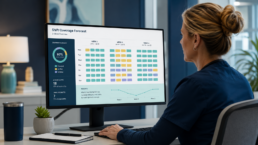
- Forecasting instead of reacting. Historical census, seasonality, and call-out patterns are enough to project where coverage gaps will land two to three weeks out. Most facilities already hold this data and use very little of it.
- Credential visibility as a live signal. Knowing which clinicians are cleared to work which units, today, removes the most common source of last-minute fill failure.
- Matching on more than availability. Setting and specialty experience, prior performance at your facility, and clinician preference all predict whether a filled shift turns into a repeat relationship.
- Measuring the flex bench like a real asset. Fill rate, time to fill, repeat rate, and cost per covered hour tell you whether your contingent coverage is improving or quietly degrading.
Why this matters for workforce operations
At Medely, we see the same shift showing up in staffing operations: as clinicians get more comfortable with AI-assisted work, expectations for the systems around them rise too, like faster confirmation, fewer manual steps, and more transparency in how shifts get filled.
Rising labor costs are part of the same picture: employers are projecting a 9.5% increase in healthcare costs in 2027, and open travel nursing positions are up 55% year over year which raises the value of coverage you can plan for rather than react to.
The practical takeaway for facility leaders is that AI literacy will accelerate data-informed practice at the bedside, and that momentum will put pressure on workforce operations to modernize as well.
The $5 million will make nurses more fluent in AI-assisted work within a few years. Facilities have that long to make their own coverage process just as fast: credentials verified in seconds, shifts confirmed in hours, forward-looking coverage planning to fill consistently, especially in thinly staffed markets.