
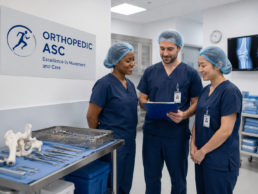
When an orthopedic ASC posts for a scrub tech or circulating RN, the job description almost always ends with the same line: must have recent ortho ASC experience, no training provided.
That language reflects what’s at stake. Orthopedic procedures run on precision, speed, and muscle memory. A circulator who has never managed an ortho instrument table, or a tech who doesn’t know the rhythm of a total joint case creates risk that a busy surgery center simply cannot absorb.
The problem is that the pool of professionals who meet that standard is shrinking at exactly the moment demand is accelerating.
What we’re hearing from orthopedic and spine facilities right now
In a third-party survey commissioned by Medely, orthopedic and spine leaders described a workforce reality that’s less about “we can’t find anyone” and more about “we can’t afford delays, manual work, or uncertainty.”
- Credentialing is the wedge pain point. 83% cited verification/compliance delays as their top credentialing challenge, and 67% said they’re manually tracking credentialing (spreadsheets/paper).
- Tech maturity is extremely low. Most respondents reported spreadsheets, an OR coordinator handling scheduling, or basic HR/payroll tools.
- Labor cost visibility shows up as a top priority. 33% selected real-time visibility into labor spend as their #1 workforce challenge, and 50% said better cost visibility is a top 12‑month priority.
- Demand is seasonal and predictable. Respondents pointed to the reality of elective case volume swings, creating recurring “surge” periods where coverage needs spike.
This matters because credentialing friction is redefining the goal: speed and certainty through pre-verified, specialty-ready talent, supported by a process that reduces administrative drag.
The numbers don’t lie
More than two-thirds of orthopedic surgeries are now happening in outpatient settings, a share that has grown as CMS has expanded which procedures can be reimbursed outside the inpatient setting. For orthopedic ASCs, that shift is a growth opportunity, but it also means more cases, more shifts, and more specialized staffing needs.
Layer on workforce constraints, and the pressure compounds quickly. Federal projections show orthopedic surgeon supply decreasing 4.3% between 2025 and 2037 while demand increases 6.4%. More surgeons performing more cases at a faster pace translates into more demand for the specialized support staff around them, scrub techs, circulating RNs, and fluoroscopy techs.
Fluoroscopy and imaging techs, in particular, have become some of the harder positions to fill, according to the U.S. Bureau of Labor Statistics, and it’s consistent with what our internal teams are seeing when facilities need fluoroscopy coverage on short notice.
Meanwhile, the financial stakes are high: ASCs are spending, on average, more than a quarter of their net revenue on personnel expenses according to Merritt Advisory.
Hospitals are competing for the same people
The competition for ortho-specialized talent extends well beyond similar facilities. Hospitals, with deeper pockets, larger HR teams, and sign-on bonuses that can reach five figures, are actively recruiting the same scrub techs and circulating RNs your ASC depends on.
For smaller and mid-size orthopedic surgery centers, the realistic levers are flexibility, consistency, and speed rather than dollar-for-dollar compensation.
The staffing model that’s working
Orthopedic ASCs that are managing this environment well share one characteristic: they built a talent pool before they needed it.
They treat per diem and contingent staff as core capacity, investing in a standing pool of credentialed, specialty-verified professionals who know their facility, their surgeons’ preferences, and their instrument sets, instead of relying on last-minute gap-fills when a core employee calls out.
This approach does several things at once:
- Eliminates the training gap. Pre-credentialed pros who have worked your facility before don’t need orientation. They show up ready.
- Reduces credentialing scramble. If verification delays are your biggest bottleneck, a repeatable bench of already-vetted clinicians turns a multi-day fire drill into a scheduling decision.
- Gives surgeons consistency. Surgeons who work with familiar support staff perform more efficiently, with fewer delays and handoff errors.
- Protects your schedule. A reliable bench keeps unexpected absences from turning into canceled cases.
What this looks like in practice
Medely’s Favorites feature allows orthopedic ASCs to designate preferred professionals, like scrub techs, circulators, and fluorotechs, who have worked their facility and met their standards. When a shift opens, those pros are notified first.
Favorites helps facilities build a repeatable bench, directly addressing what orthopedic and spine leaders shared in a third-party survey commissioned by Medely: credentialing delays and manual tracking are holding them back as much as (or more than) demand itself.
The window is narrowing
The orthopedic staffing market is unlikely to get easier in the near term. Procedure volumes are rising as more cases move outpatient, the orthopedic surgeon workforce is projected to tighten, and hospitals will continue recruiting allied health professionals away from outpatient settings.
The facilities that are building their sustainable workforce by identifying reliable pros, credentialing them in advance, and maintaining those relationships through consistent bookings, will be better positioned when the next staffing crunch hits.
Acting only after you’re short-staffed means competing for a smaller pool of available talent, at higher cost, with less time to be selective.
Building your bench is an investment, and one that pays back faster than the cost of going without.
Medely Newsroom
September 4, 2026

Medely Resource Library
May 13, 2026

The three decisions leaders control before healthcare burnout
October 22, 2026

5 times contingent labor makes your facility stronger
October 20, 2026

Unlock simplified multi-specialty hospital staffing coverage
October 15, 2026


How healthcare facilities can prepare for busy season
October 1, 2026